Benchmark · Full-Duplex Speech · Document Grounding

DuplexSpeechBench — Document Grounding

Benchmarking Document Grounding and Hallucinations in Full-Duplex Voice Agents

1Adobe Research, San Jose, USA  ·  2University of Maryland, College Park, USA
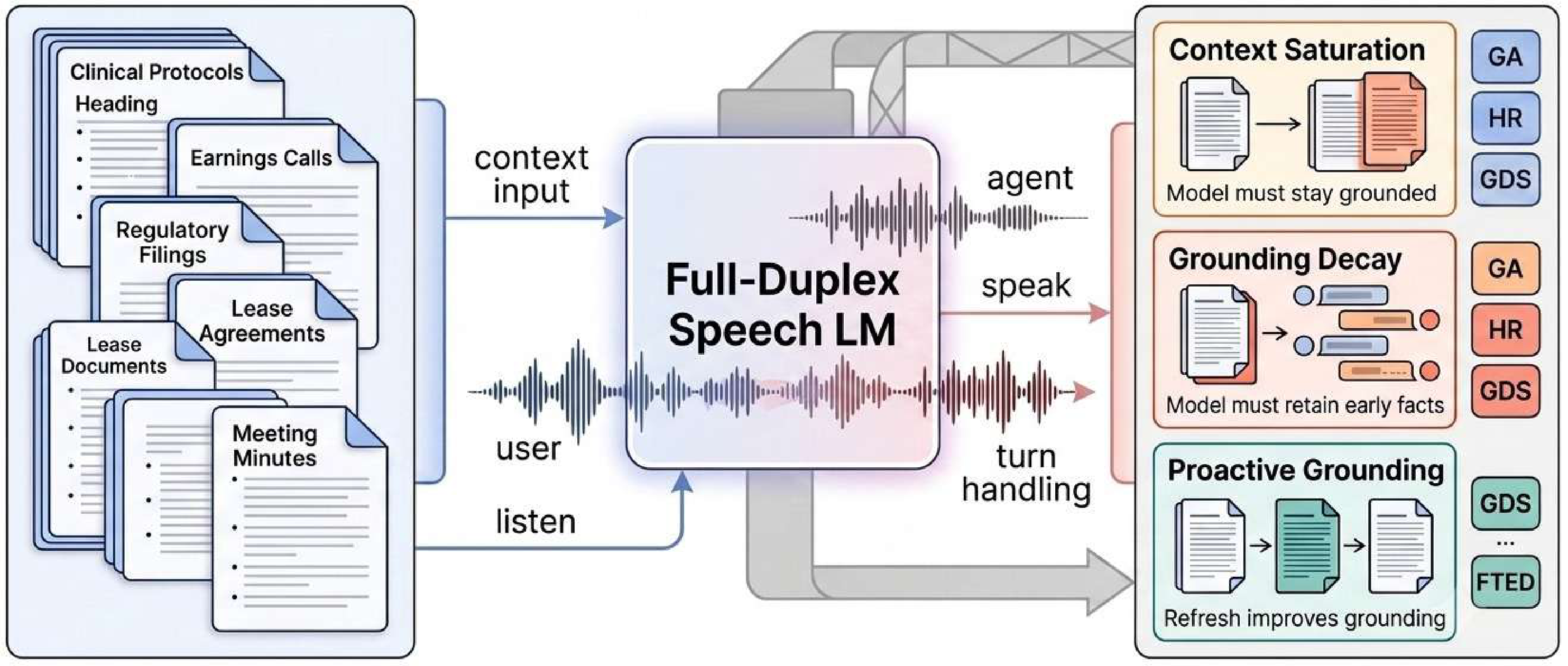
DSB-DG overview: professional documents provide context to a full-duplex speech LM that listens and speaks, evaluated by three protocols — Context Saturation, Grounding Decay, and Proactive Grounding — via grounding accuracy, hallucination rate, decay score, and latency.

Overview

Can a voice agent stay faithful to a document while it speaks?

Full-duplex speech agents listen and speak simultaneously, enabling low-latency, natural interaction. Yet as they enter professional settings, fluency is not enough: users expect answers grounded in task-specific documents — clinical protocols, earnings calls, contracts, regulatory filings. Under contextual load, a fluent but ungrounded spoken reply can deliver a hallucination with the same prosodic confidence as a grounded one. DSB-DG is a streaming-native benchmark that isolates when full-duplex models retain, lose, or recover access to external context.

1,636
Verified QA pairs
50
Documents · 5 domains
5
Context tiers
(≈500→8k tok)
6
Systems evaluated
20
Multi-turn dialogues
3
Grounding protocols
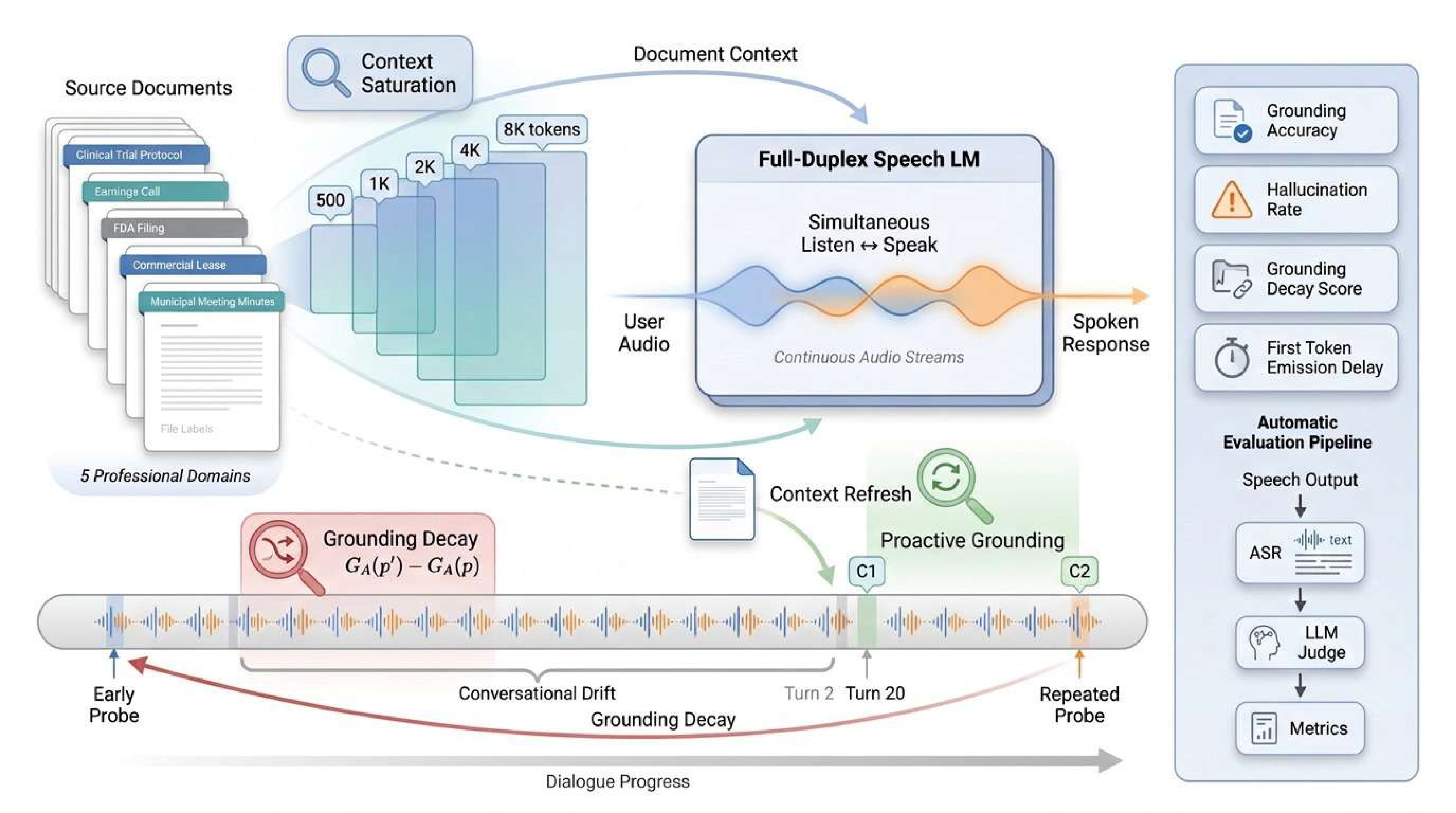
DSB-DG framework: source documents across five domains are rendered at five context tiers (500–8k tokens) and injected into a full-duplex speech LM that answers spoken queries in real time. Three protocols — Context Saturation, Grounding Decay (early vs. repeated probes across conversational drift), and Proactive Grounding (mid-dialogue context refresh) — feed an automatic evaluation pipeline: ASR, LLM judge, then metrics.

The DSB-DG framework — document context and spoken queries drive a full-duplex speech model, evaluated by three complementary protocols and a fully automatic ASR → LLM-judge → metrics pipeline.

Three complementary protocols

Isolating distinct grounding failure modes

Each protocol holds the question and its supporting evidence fixed while varying one stressor, so changes in grounding can be attributed to that stressor alone.

📏
Experiment A

Context Saturation

Does grounding degrade as the document grows from ≈500 to 8,000 tokens? The same spoken question is asked under five prefix-consistent context tiers.

Grounding Accuracy · Hallucination Rate
🧠
Experiment B

Grounding Decay

Does the model forget document facts over a 20-turn conversation? A probe→distractor→repeat schedule replays identical early probes as late probes.

GDS = GA(A′) − GA(A)
🔄
Experiment C

Proactive Grounding

Does re-injecting the document mid-conversation help — or overwhelm a limited context window? No / single / multiple refreshes.

Δlight · Δheavy · Δmarginal

Benchmark design

50 professional documents · 5 structurally distinct domains

Candidate QA pairs are generated from restricted document context, then passed through a three-stage adversarial verification pipeline — answerability, ambiguity, and cross-tier checks — yielding 1,636 verified QA pairs (1,341 grounded + 295 unanswerable). All user turns are spoken (16 kHz mono, fixed TTS voice); answers are transcribed with Whisper-large-v3 and scored by a GPT-4o grounding judge validated at >90% agreement with human annotation.

Domain# Docs# QAAvg Q/DocDocument characteristics
Clinical Trials1039139.1Structured protocols, eligibility criteria, clinical endpoints
Earnings Calls1031431.4Financial reporting, analyst Q&A, dense numerical content
FDA 510(k)1029229.2Regulatory filings, device specifications, standardized structure
Commercial Leases1035835.8Contract clauses, cross-references, legal reasoning
Municipal Minutes1028128.1Procedural narratives, motions, amendments, voting records
Total501,63632.7+ 20 multi-turn spoken dialogues

Table 1 — Domain composition and dataset statistics of the released benchmark.

📦 Available on Hugging Face: puneetm/DSB-DGbenchmark.json, five nested document tiers, 1,636 spoken-question clips, and 20 conversation scripts. (Access-gated during review; downloadable with an HF_TOKEN.)
Results

Six systems, qualitatively distinct failure modes

We evaluate a cascaded oracle (Whisper→GPT-4o→TTS), two strong real-time systems (GPT-Realtime, MiniCPM-o), and three open-weight systems (Ultravox-v0.6-Qwen3-32B / UV-32B, SALMONN, Moshi). Increasing document length produces distinct failure regimes rather than a common degradation curve.

Cascaded leads; strong real-time systems close in

Cascaded holds 93.6% GA at the 2k tier; GPT-Realtime (89.3%) and MiniCPM-o (91.8%) approach it under real-time speech generation.

SALMONN — context-capacity cliff

Grounding collapses from 62.1% → 13.1% at T3→T4 (−49 pp), with hallucination surging to 48%: the model keeps talking after losing the document.

UV-32B — severe multi-turn decay

Among competent grounders, UV-32B shows the largest conversational forgetting: GDS −11.7.

Moshi — fluent but ungrounded

Fails to produce document-grounded answers across every tier (~0% GA); an effective context budget of only a couple hundred tokens.

Grounding Accuracy under context load

Experiment A · GA (%) vs. context tier

Hallucination rate under context load

Experiment A · HR (%) vs. context tier

Experiment A — Grounding Accuracy by tier

Table 2 — GA (%) across token-length tiers. Moshi–EC is the extractive-compression variant restricting injected context to query-relevant content.

Experiment B — Grounding Decay

GDS = GA(A′) − GA(A) over 20-turn conversations; negative = forgetting.

Experiment C — Proactive Grounding

GA under no / single / multiple refreshes. Re-injection helps strong systems, hurts smaller backbones.

Latency & the quality-adjusted frontier

Table 5 — First-Token Emission Delay (FTED) and Quality-Adjusted Latency (QAL = FTEDp50·(1−GA@T3)). Cascaded and GPT-Realtime dominate the quality-adjusted frontier; Moshi is fast but does not ground.

Qualitative examples

Listen to the questions. Compare every model's answer.

The Audio Explorer pairs each real spoken question with all six systems' transcribed replies and the grounding-judge verdict — grounded, hallucination, or calibrated refusal — filterable by domain, tier, and failure mode.

🎧 Open the Audio Explorer

Citation

Cite DSB-DG

@inproceedings{mathur2026duplexspeechbench,
  title     = {{DuplexSpeechBench -- Document Grounding}: Benchmarking Document
               Grounding and Hallucinations in Full-Duplex Voice Agents},
  author    = {Mathur, Puneet and Lipka, Nedim and Jin, Zeyu and Manocha, Dinesh},
  year      = {2026}
}